 Reviews



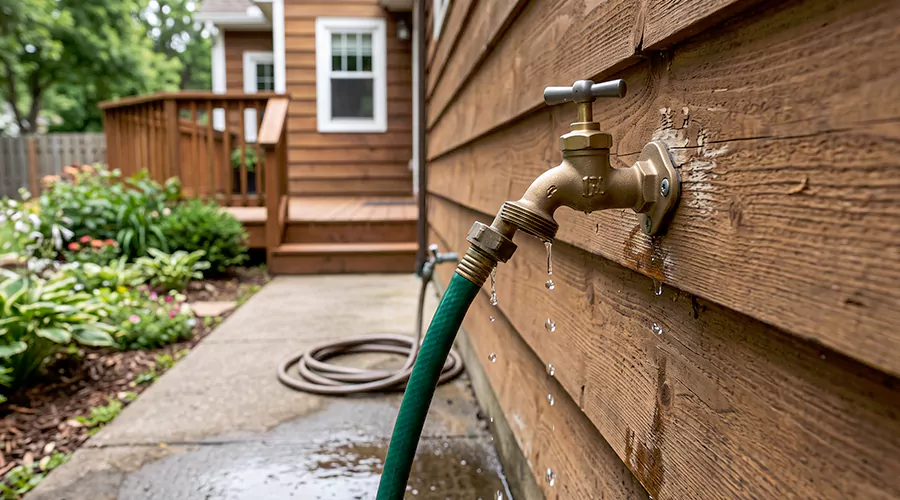
An outside faucet commonly leaks because its internal washer or stem packing has deteriorated. A damaged hose connection can also cause water to spray during use. However, water appearing near the wall may indicate a more serious problem involving the faucet's supply connection. Faucet repair can address worn washers, damaged packing, loose connections, and other common causes of outdoor faucet leaks.
Professional outside faucet repair typically costs 100–300 in the United States in 2026. Complete replacement usually costs 120–500 depending on the faucet type and installation conditions.
This guide focuses on identifying the failed component and determining whether the problem can be repaired without replacing the entire fixture.
What Are the Main Reasons an Outside Faucet Leaks?
Outside faucets contain components that wear through repeated operation and exposure to weather.
The failure may involve a replaceable sealing component or damage to the main faucet body.
Common causes include:
- Worn rubber washers.
- Loose packing nuts.
- Damaged stem packing.
- Deteriorated hose washers.
- Defective vacuum breakers.
- Corroded valve components.
- Freeze-related damage.
- Cracked supply connections.
The exact cause depends on the faucet design and where water escapes.
A standard outdoor faucet may use different internal components from a frost-free model.
How Do You Identify Your Outside Faucet Type?
Before attempting repair, determine which type of faucet is installed.
Outdoor faucets are available in several designs.
| Faucet Type | Main Characteristic | Repair Consideration |
|---|---|---|
| Standard hose bib | Conventional outdoor valve | May use replaceable stem washers |
| Frost-free faucet | Shutoff positioned farther inside the wall | May contain a long valve stem |
| Anti-siphon faucet | Includes backflow protection | Vacuum breaker may require attention |
| Specialty outdoor faucet | Manufacturer-specific construction | Requires compatible parts |
The faucet's construction determines how its internal stem can be removed.
Do not assume that every outdoor faucet can be disassembled using the same procedure.
Identifying the manufacturer can prevent incorrect replacement-part purchases.
What Does the Leak Location Tell You?
The first visible leak location is often the strongest diagnostic clue.
| Leak Location | Possible Cause | Recommended Investigation |
|---|---|---|
| Spout while closed | Worn shutoff washer | Inspect the valve |
| Handle while running | Damaged packing | Check the stem seal |
| Hose connection | Defective hose washer | Inspect the hose |
| Vacuum breaker | Damaged internal component | Check device specifications |
| Exterior wall connection | Loose or damaged connection | Trace the moisture |
| Interior wall | Hidden supply or faucet damage | Stop use and isolate the supply |
Water travelling down the faucet body can make the source difficult to identify.
Always dry the fixture before performing a controlled test.
How Can You Tell Whether the Leak Is Getting Worse?
A developing outside faucet leak may show several symptoms before a major failure occurs.
Watch for these warning signs:
- Dripping continues after shutoff.
- The handle becomes increasingly difficult to turn.
- Water escapes around the stem.
- A garden hose connection begins spraying.
- The vacuum breaker releases excessive water.
- The faucet develops visible corrosion.
- Water accumulates near the foundation.
- Dampness appears inside the exterior wall.
- The leak becomes worse after freezing weather.
- Previous washer repairs no longer stop dripping.
The final signs deserve particular attention because they may indicate that an ordinary seal problem has developed into a larger plumbing issue.
How Do You Test an Outside Faucet Safely?
A staged inspection can identify many accessible faucet leaks without opening the plumbing.
The test should separate the faucet from its garden hose.
Follow these steps:
- Remove the hose. Disconnect other attachments as well.
- Dry the faucet. Remove moisture from the handle and body.
- Check for dripping. Observe the spout with the handle closed.
- Open the faucet briefly. Watch the packing area.
- Inspect the vacuum breaker. Check for unusual discharge.
- Close the faucet. Observe whether dripping stops.
- Reconnect the hose. Test the hose connection separately.
- Inspect the wall. Check for moisture around the mounting area.
Stop the test if water appears inside the wall or the faucet body is visibly cracked.
How Do You Fix an Outside Faucet That Drips While Off?
A conventional compression-style outdoor faucet often uses a rubber washer at the end of its valve stem.
The washer presses against the valve seat when the handle is closed.
A worn washer may no longer prevent water from passing through.
For a suitable conventional faucet, the general repair sequence is:
- Shut off the faucet's water supply.
- Open the outdoor faucet to relieve pressure.
- Confirm that water has stopped flowing.
- Remove the handle according to its design.
- Access the stem assembly.
- Inspect the rubber washer.
- Check the valve seat for damage.
- Install the correct replacement washer.
- Reassemble the faucet.
- Restore water gradually and test.
Do not attempt this procedure on an unfamiliar frost-free faucet without first checking its manufacturer instructions.
Angi identifies washer replacement as a common repair for conventional leaking outdoor faucets.
How Do You Fix Water Leaking Around the Handle?
A leak around the handle commonly indicates that the stem packing is loose or deteriorated.
The packing forms a seal around the moving shaft.
Some faucets have an accessible packing nut that allows a minor adjustment.
A careful adjustment may correct a loose seal, but excessive tightening can damage components.
If adjustment does not work, the packing may need replacement.
Before removing the packing assembly, shut off the water supply and release pressure.
Use the correct replacement material for the installed faucet.
Do not treat a cracked valve body as a packing problem.
How Do You Fix a Leaking Hose Connection?
A garden hose connection normally contains a rubber or nylon washer.
This washer compresses against the faucet outlet and forms a seal.
When it deteriorates, water can escape through the threaded connection.
Inspect the hose washer first.
Replace it if it is cracked or missing.
Then reconnect the hose without overtightening the fitting.
Test the connection while water is flowing.
The EPA specifically recommends checking garden hose washers and replacing damaged components when leaks occur.
A damaged hose fitting may require replacing the connector rather than the faucet.
Why Does an Outside Faucet Leak After Winter?
Outdoor faucets can develop leaks when trapped water freezes and damages the valve body or connected piping.
This problem is particularly relevant to frost-free faucets that have not drained correctly.
A hose left attached can trap water in a section designed to empty when the valve closes.
Woodford explains that frozen trapped water can rupture a frost-proof faucet despite its protective design.
A leak caused by a split internal tube may become visible only when the faucet is turned on.
Inspect the surrounding wall before using a faucet that may have suffered freeze damage.
When Should You Replace the Entire Outside Faucet?
Replacing the faucet may become necessary when the body is cracked or internal damage cannot be corrected with suitable replacement components.
The condition of the supply connection also matters.
Replacement becomes more relevant when:
- The faucet body is cracked.
- Severe corrosion affects the valve.
- The internal stem is damaged beyond repair.
- Freeze damage has occurred.
- Compatible replacement parts are unavailable.
- Previous repairs have repeatedly failed.
A standard outdoor faucet replacement can cost 120–250 in the United States. Frost-free models commonly cost 180–350 to replace.
These figures do not include extensive repairs to damaged pipes inside the wall.
When Should You Call a Professional?
Professional assistance is appropriate when the faucet cannot be isolated safely or the repair involves inaccessible plumbing.
Seek additional help when:
- Water leaks inside the exterior wall.
- The connected supply pipe is damaged.
- The faucet has severe freeze damage.
- The main shutoff valve cannot be operated safely.
- The faucet body is cracked.
- The same problem returns after component replacement.
- Water has damaged the surrounding building materials.
Hidden leaks should be addressed before they spread into surrounding structural materials.
How Can You Prevent Future Outside Faucet Problems?
Regular maintenance reduces unnecessary wear and helps identify leaks before they become more serious.
Recommended habits include:
- Disconnect garden hoses before freezing temperatures.
- Follow the manufacturer's winterization instructions.
- Inspect hose washers periodically.
- Check for moisture around the handle.
- Avoid overtightening the valve.
- Inspect the faucet after winter.
- Respond to persistent dripping.
Keep the surrounding wall connection visible for inspection.
For frost-free models, correct drainage is important.
A hose or attachment that prevents drainage can compromise the faucet's freeze protection.
Conclusion
If your outside faucet is leaking, begin by identifying the first point where water appears. A persistent spout drip commonly indicates a worn washer. Water around the handle may involve stem packing, while a hose connection leak can result from a damaged hose washer.
Leaks following freezing weather deserve additional investigation. Replace damaged components when suitable, but seek professional repair when water is escaping inside the wall.
Frequently Asked Questions
Why is my outside faucet leaking when turned off?
A worn internal washer or damaged valve seat may be preventing complete shutoff.
Why does my outside faucet leak around the handle?
The stem packing may be worn or the packing nut may need adjustment.
Can a garden hose cause an outside faucet leak?
Yes. A damaged hose washer or fitting can cause water to escape during operation.
Why does my outside faucet leak only when running?
The problem may involve the handle packing or another connection that carries water during operation.
Can freezing weather cause a hidden faucet leak?
Yes. Water trapped inside a frost-free faucet can freeze and damage piping inside the wall.